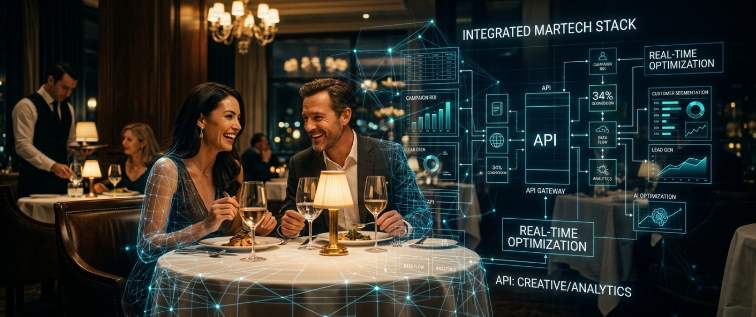
For the past decade, growth marketing was a creative arms race, and a bigger ad budget could paper over almost any problem. That era is over. Today, your customer acquisition cost (CAC) is climbing not because your ads are ugly, but because your marketing technology is fragmented. Customer acquisition has quietly become a MarTech problem, and the brands that scale profitably in 2026 are the ones that treat it that way. Below, we break down why an integrated marketing technology stack — not a fatter ad spend — is the real growth lever for restaurants, hospitality groups, and consumer brands.
1. The $100 Illusion: Why Great Creative No Longer Lowers Your Customer Acquisition Cost
Let's be honest about the current state of digital marketing. For the last decade, the playbook was essentially a license to print money. You hired a trendy creative agency, shot some beautiful high-definition product video, wrote a witty headline, and poured a mid-sized budget into Facebook and Google Ads. If the creative was remotely appetizing, customers materialized.
That era is officially dead.
Today, Meta's and Google's algorithms are smarter than any media buyer you can hire. These AI-driven ad platforms have completely democratized the top of the funnel — they are shockingly good at finding the right human eyeballs. But because every competitor has access to the same automated ad platforms, great creative is no longer a differentiator. It is merely the baseline entry fee to get onto the court.

The real train wreck happens further down the funnel. We see enterprise brands and upscale restaurant chains spending fifty thousand dollars a month on ad spend, running beautiful campaigns, yet watching their customer acquisition costs skyrocket and their return on ad spend (ROAS) collapse. Why? Because they treat growth as a creative storytelling problem when it is actually a technology synchronization problem. You can run the most breathtaking ad in the world, but if the customer experience fractures the millisecond after the click, you are not growing a business — you are just donating money to Silicon Valley.
2. The Frankenstein MarTech Stack: The Hidden Friction Killing Your Conversion Rate
Walk into the back office of almost any mid-market consumer brand or regional hospitality group and you'll find a marketing technology stack that looks like a digital Frankenstein monster.
Social ads run on one platform. The digital menus, online reservation engine, or e-commerce storefront live on another. SMS and loyalty marketing sit with a separate vendor. And the point-of-sale (POS) data — the only data that actually proves revenue — sits isolated in a corner, completely divorced from the rest of the business.
This is where your cash flow silently bleeds out.
Consider a practical example. A diner sees a targeted ad for a premium dining experience in their Instagram feed on a rainy Tuesday. They click. They are redirected to a slow-loading, clunky third-party reservation link. They hit a manual-entry bottleneck, get distracted, and drop off.
In the traditional agency model, the creative team looks at the dashboard, sees a high click-through rate, pops champagne, and declares the campaign a success. Meanwhile, the owner stares at empty tables on a Tuesday night, wondering where the revenue went. Because these applications don't talk to each other natively, you have zero data attribution. You are forced to optimize for vanity metrics like engagement and impressions, because your marketing technology stack is too fragmented to track actual dollars.
3. The Revenue Fix: Orchestrating an Integrated MarTech Stack and Applied AI
Fixing this doesn't require a bigger ad budget. It requires structural orchestration. The most sophisticated operators have realized that the creative team and the technology stack have to run as a single, unified engine.
When you shift from isolated ad campaigns to an integrated MarTech framework, the entire commercial dynamic changes.
Take applied AI. We are not talking about using ChatGPT to crank out generic blog posts. True behavioral AI works quietly in the background of your funnels. It reads real-time user behavior on your digital menu or checkout page, pinpoints exactly where customers drop off, and dynamically adjusts the interface or menu layout on the fly — a continuous form of conversion rate optimization (CRO).
An integrated stack also wires your creative assets directly to automated, cross-channel triggers. If a user engages with a high-margin menu item online but leaves before booking, an intelligent marketing automation system fires a personalized text or email an hour later. This isn't a generic discount code that erodes your margins; it is a contextual, well-timed invitation that pulls the customer back into the funnel while their intent is still warm. That is how you close the loop between an ad click and verified, attributable revenue.
4. The Next Horizon: Customer Data Platforms (CDPs) — Without the Hype
If you read the modern technology press, every enterprise software salesperson will tell you to drop six figures tomorrow on an enterprise-grade Customer Data Platform (CDP) or you won't survive.
Let's inject some reality.
A Customer Data Platform — a central repository that unifies every digital footprint, point-of-sale transaction, and customer preference into one persistent profile — is absolutely the future frontier of hyper-personalization. It is the engine that will eventually let a brand know a guest's favorite table, their preferred vintage, and their exact dining patterns before they walk through the door.
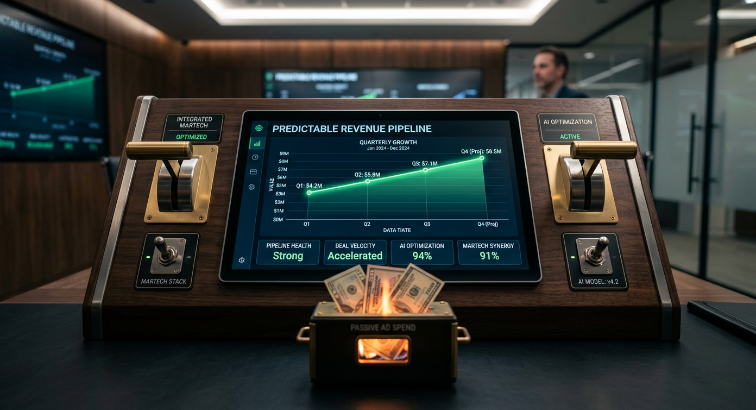
But buying a complex data platform before your basic marketing technology channels are unified is like buying a Ferrari engine when you don't yet have wheels. The immediate, high-return win for mid-market brands is to integrate and optimize your active MarTech channels today. Build the responsive, automated conversion loops first. Once that foundation reliably turns traffic into revenue, you've earned the right to layer on a CDP and advanced first-party data infrastructure.
5. The Verdict: Stop Renting Ad Platforms, Start Building MarTech Systems
At the end of the day, scaling a modern business means moving past the outdated belief that marketing is strictly a visual art form. Beautiful creative and high-performance execution matter — but without an integrated technology framework behind them, they are toothless.
This is the exact philosophy behind Yookti. We realized early that businesses don't need another generic agency delivering pretty graphics and a monthly invoice. Backed by a global capability engine of 350+ full-time MarTech specialists, creative designers, and applied-AI developers, we don't just launch ad campaigns. We build, manage, and optimize integrated MarTech solutions and specialized AI Labs that turn customer acquisition from an unpredictable expense into a predictable, trackable revenue engine.
Stop guessing what your ad spend is actually doing. Explore our MarTech and infrastructure deployment strategies at yookti.com.